In Fabruary 2010, two sweet chestnut trees were planted in east London’s Back Church Lane – which links Commercial Road and Cable Street. ‘Back Church Lane’ is somewhat of a misnomer, given there is no church nor does it bear any resemblance to a lane in the rural sense. It does have a winding shape as it imperceptibly descends towards Cable Street but there were never any trees – until one chilly grey day in January.
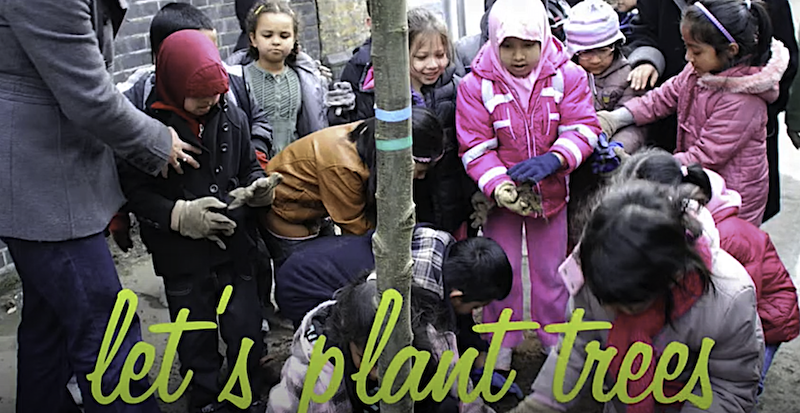
Following some lobbying for the need to plant trees at a local council event which was allocating funds for community activities a couple of trees were sited at both ends of Back Church Lane. Trees For Cities had been commissioned to do the physical planting and we chose a Sweet Chestnut. The children from the local Shapla Primary School were mobilised to ceremoniously plant the tree outside our premises. It seemed that the tree at the top of the lane was forgotten – it too was a sweet chestnut and was planted outside Harry Gosling, another local school which sits between Back Church Lane, Fairclough and Henriques Street.
Back Church Lane now had two sweet chestnuts – one each at both ends of the street. For some years both trees were protected with a wire fencing surround, until they outgrew these.
Alongside the physical benefits of having trees in the street, observing their growth and comparative yield of fruit over the past ten years runs parallel to the changing demographics, lifestyle and attitudes of the neighbourhood.
At one end of the street near to a major busy main road, dug into the heartless concrete and tarmac of the narrow pavement which runs alongside the walled off school building is a ten year old chestnut tree. It has grown up towards the sky against all the odds. It is oblivious of its sibling located just a hundred metres south, obscured by the dog leg bend in the lane passed the ‘Dog and Truck’ pub. The girth of the chestnut tree in the south is twice the size, it’s leaves and branches abundantly shade the street and obscures the massive brick walls of the Victorian Railway viaduct, it generously showers the lane with fruit during the early autumn. While observing the trees it’s impossible not to recollect the children who were herded out from school on a grey winters day to plant a tree. These children have also changed. They are all ten years older. Maybe many of them will be finishing school – maybe studying for their A Levels, preparing for university, or struggling with poor GCSE results. Maybe they have given up on formal education and started work in a local supermarket, bank, shop or as an apprentice on a local building site. The little children would be more unrecognizable than the trees. But they would reflect the way the trees have developed. Some flourishing and strong, with some evidence of the knocks and disappointments life throws up – such as the way tall lorries thoughtlessly carve away the leaves and branches on the street side of the trees, the clumsy vindictiveness of others who strip off the bark or foul the soil or abuse the tree’s location as a dumping ground…. What happened to the children? How did the children grow?